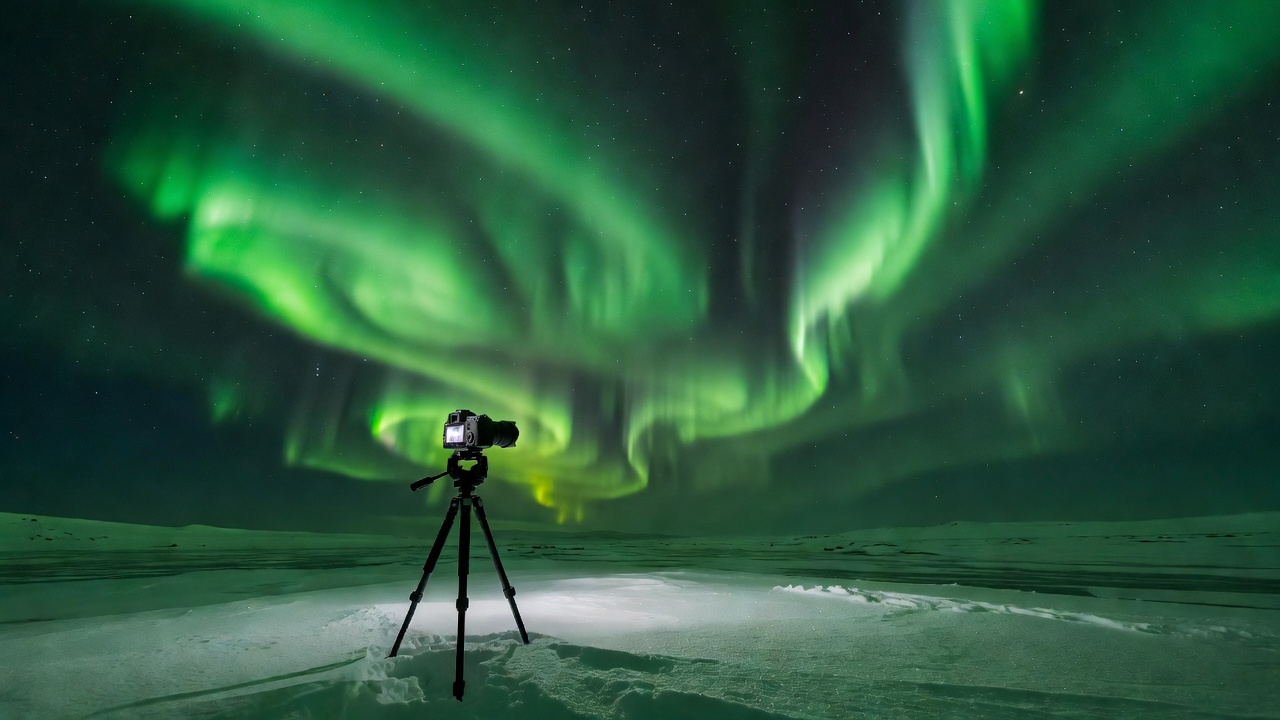
The Core Rule: Manual Focus on Infinity
In the dark of night, autofocus will hunt continuously and fail. You must switch your lens to Manual Focus (MF).
Use your camera's live-view screen, magnify a bright star or distant terrestrial light to 10x zoom, and rotate the focus ring until the point of light is pin-sharp and as tiny as possible. Tape the focus ring down with gaffer tape so it cannot slip when you adjust framing.
Recommended Exposure Settings Matrix
| Aurora Condition | Aperture | Shutter Speed | ISO Setting |
|---|---|---|---|
| Faint Arc / Low Activity | f/1.4 – f/2.8 | 8 – 15 seconds | ISO 1600 – 3200 |
| Active Dancing Curtains | f/1.4 – f/2.8 | 2 – 5 seconds | ISO 3200 – 6400 |
| Explosive Overhead Corona | f/1.4 – f/2.0 | 0.5 – 1.5 seconds | ISO 6400+ |
Why Shutter Speed Must Be Fast for Dancing Auroras
When the aurora begins to ripple and curl quickly, an exposure longer than 4 seconds will blur all the distinct ray structures into a flat green smudge. Keep shutter speeds around 1-3 seconds and increase ISO to preserve the delicate vertical ray textures.
Equipment Essentials for Sub-Zero Shooting
- Fast Wide-Angle Lens: 14mm to 24mm full-frame equivalent with an aperture of f/1.4, f/1.8, or f/2.8.
- Heavy-Duty Tripod: Arctic winds are unforgiving. Lightweight travel tripods will shudder during multi-second exposures. Remove the center column hook weight bag if needed.
- USB Lens Heater Strip: In cold, humid climates like coastal Norway, frost forms on front lens elements within 20 minutes. A 5V USB heating belt prevents dew and ice crystals.
- Spare Batteries in Warm Pockets: Keep backup lithium batteries inside an interior jacket pocket near your body heat. Swap them when your active battery hits 20%.
Lens Condensation Protocol
When returning indoors after a -20°C shooting session, NEVER take your camera out of your bag immediately. Seal the camera inside your camera backpack while still outdoors. Let the bag sit unopened in your warm room for at least 2 hours to allow the equipment to warm up gradually without condensation coating your internal sensor.